Sunday, October 25, 2009

House of Museums

A very interesting museum in the western outskirts of Bangkok is the House of Museums (บ้านพิพิธภัณฑ์), where lots of everyday items of the 1950s and 1960s are collected and displayed.

On the ground floor is one corner with lots of toys, mostly tin toys, and since we went to the museum with our small daughter this corner we spend most of the time - she could not get her eyes off from the many toys, all so much different from those she is used to nowadays. There are further two old style shops, though while such a shop layout itself can still be found in Thailand away from the big malls of Bangkok, I could only wonder that so many of the old product packaging was kept by collectors. There also a small shop of old-style toys, though most in plastic already, as well as some treats. Also, directly at the entrance next to the counter are the books by Anake Nawigamune (เอนก นาวิกมูล), the founder of the museum and a very productive writer on many historical topics. Sadly the books are all only in Thai, only the photos inside might be of interest for those living behind the language barrier.

The first floor features a printing press, a barber shop, a photographer shop, and a kitchen, all with the historic utensils. Another room just has many mixed historic items, like a historic playing car, musical instruments, games, dolls. Even more interesting for me was the second floor, especially the office of a district officer as well as an old school room. Finally on the ground floor of the neighboring house is the workplace of a dentist, a Chinese gold shop (still looking much similar to the ubiquitous gold shops of Bangkok).

Though we spend more than an hour in there, we had to hurry through the last rooms since we had another appointment later the day. But as this museum is located close to the home of my brother-in-law, it won't be my last visit there for sure.

The museum is run by a private club and is therefore only open in the weekends when the members don't need to work. It is quite easy to find when driving yourself, from the city center on the highway to Nakhon Pathom (but don't use the elevated one which has only few exits), then right after the intersection with the ring highway change to Phutthamonthon Sai 2 to north, turn left at the end and shortly after at the sign left again.

Sunday, October 4, 2009

Baan Rabiang Dao resort near Khao Yai

Normally I don't write about resorts or hotels here, as for me these are mostly the places to spend the night and I prefer to explore the attractions around. So we don't go to the expensive resorts and choose a plain hotel room instead. But since it was a nice and special place we stayed together with the Thai family two years ago I'll give it a try to deviate from the normal contents here this time. Just to make it clear - I wasn't paid for this posting, nor am affiliated in any way with the resort.

The resort is named Baan Rabiang Dao, yet the part we stayed was named Ban Ruea Resort (บ้านเรือรีสอร์ท), literally house boat resort. The name and the photos already explain the theme of the resort - the rooms are inside traditional styled houseboats. As we were traveling with all family we filled a large boat completely - actually we were even more than the 6 persons normally planned for a single home. As it is a relatively expensive resort we only stayed one night, but it was definitely a pleasant stay. Especially the children liked the pool a lot, and luckily we could borrow swimming suits from the resort as not all of us did bring our own.

The resort is located near Khao Yai national park, and it was very quiet around it. Only when I now searched to pinpoint the location exactly I learned that very close to the resort is the Gran Monte winery - we visited a winery next day, but that was the Vin de Ray in neighboring Saraburi.

Sunday, September 27, 2009

District museum Thonburi

One of the local district museums I should mention here is the one of Thonburi. It is relatively easy to reach, has several nice exhibits, but most of all the caretaker was that much concerned about me getting most of the museum it was nearly annoying already. As she did not speak much English, she instead read the text on the plates next to the exhibits.

The museum is located in the 3rd floor of the temple school of Wat Prayurawongsawat, most famous for the replica mountain known as "turtle mountain". It is located right across the river at Memorial Bridge. The temple itself is also worth a visit, but one wouldn't find this museum at all strolling around on the temple grounds. It has a sign on the street outside the temple complex, but not a single hint inside to guide to the school. In the brochure of the temple it has a photo of a sign in front of the school, but I did not notice that one in there. So once I found the school building I asked at the kiosk in front and it quickly had someone guide me upstairs to the rooms occupied by the museum. Felt quite odd to pass the school rooms full with pupils to reach a museum.

The museum itself consists of two rooms, and since it was a very hot day and I was on a walking tour visiting several of these museums the fact one of it was acclimatized was quite comfortable. Since the district shares its name with the historical capital - though the actual palace back then is in Bangkok Yai now - and the former province covering the area west of the Chao Phraya river, these histories are prominently displayed on the posters. It was one of these posters where I learned that the former province hall of Thonburi is located just around the corner of the temple.

Of course the local artisans are featured as well, music instruments from (if I recall correctly) Lao settlers including audio recordings to listen, or the Khon mask shown to the left. Also, photos and descriptions of the main religious sites in the district are shown - apart from the Buddhist temples Wat Kanlayanamit and Wat Prayurawongsawat the Santa Cruz church and the only Mosque built like a Thai temple building are the most prominent ones. These alone already gave me enough ideas of places to visit next time I am out for a walking tour in Thonburi.

Sunday, September 20, 2009

Prasat Phanom Wan

Prasat Phanom Wan (ปราสาทหินพนมวัน) is a Khmer temple ruin located between the more famous and big one in Phimai and the city Nakhon Ratchasima (Khorat). It consists of a about 50x50 m big area enclosed by a stone wall, with a single shrine in the middle.

I went there on the return way from Phimai, so this much smaller and less reconstructed site failed to impress me that much after seeing Phimai, but the fact that I was the only one exploring there and the more ruined state also has a lot charm. Since I did a lot of photos in Phimai already, I only did very few there, and only one turned out good enough to show here. But on Wikimedia Commons it has several more from other visitors.

I only came to go there because I bought a book on Khmer sites in Thailand in preparation for the visit to Phimai, and noticed that there a second place which nearly on the way. According to that book, this temple was built between the late 9th and late 11th century, and was used for Shiva worship, and at other times Vishnu worship and finally Buddhism was practiced there. It was rediscovered by the French explorer Henri Mouhot in 1861.

Sunday, September 13, 2009

City pillar shrine of Suphanburi

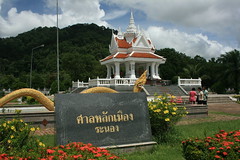
As I am fascinated by the city pillar shrines, which it has in almost every provincial city and also some others, after I saw the photos of the shrine in Suphanburi in the tourismthailand blog this particular site not too far from Bangkok was quite high on my list of places I need to visit. The dragon museum showing an exhibition on the history of the Chinese, located right next to the shrine, made the place even more interesting.

However already when we were underway in Suphanburi I could get a brochure from the museum, and once seeing the entrance fees the interest shrinked a lot. No one of my Thai family was considering it worth the 300 Baht, and as a foreigner I would even have to pay 500 Baht - the infamous Thai double pricing. As a little reality check - the Louvre in Paris is 9 Euro for a normal day ticket, or as of today close to 450 Baht. And I doubt it has anything spectacular like the Mona Lisa in the dragon. So I only took a few views from the outside and will delay the inside until the pricing gets more reasonable. Yet if you're interested in a report on what to expect inside, Richard Barrow was there already.

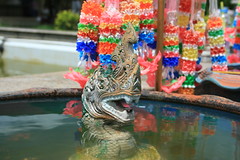
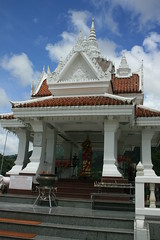
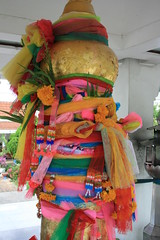
But even skipping this museum the site definitely was worth the visit, as the city pillar shrine is probably the most lavishly decorated one of all Thailand. But this is also due to the fact that it is one of the few city pillar shrines built like a Chinese temple, which are known for their colorful decorations. The central part are of course the pillars, two gold-covered statuettes. In front of the shrine many people pray, light the incense candles, just like in the Buddhist temples.

But not just the place in front of the shrine and the inside of the building is worth looking at, even on the backside it has paintings. There are also some additional buildings in the behind - the furnace for burning larger gifts to the ancestors is a standard found in every Chinese temple. It further has a large meeting hall, and still partially under construction at my visit a huge tower,

Since I have taken more photo than would fit into this posting, I have created an album in Flickr to show the whole set.

Sunday, September 6, 2009

Wat Khao Suwan Pradit, Don Sak

Most tourists only know Don Sak, the easternmost district of Surat Thani province, only because the main ferry from the mainland to Ko Samui leaves near this small town. Though it is not that spectacular, a stop-over in the town is a worth it, not just the sea food restaurant directly at the mouth of the small river into the sea. On the hill overlooking the town is the temple Khao Suwan Pradit (วัดเขาสุวรรณประดิษฐ์) - literally the "hill of artifical gold".

The buildings at the entrance, the area usually used for parking the park, are not much spectacular, the only interesting was a smaller shrine with the mummy of a monk inside. I guess this is Luang Pho Choi (หลวงปู่จ้อย), who founded the temple in 1982. To me it seemed quite strange to have him laid out in that glass shrine.

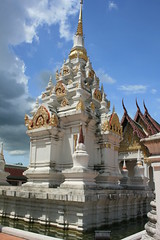
But the much more interesting place is reached after walking up the long stairs. These lead to the hilltop pagoda, a beautiful white chedi surrounded by a building. This chedi enshrines a Buddha relic, originally from Chiang Mai. But for me as a non-Buddhist, apart from the beautiful building the view from the hill to the sea was much more breathtaking. One can see the Ang Thong archipelago and Ko Samui easily, as well as look down to the town center.

As this temple and especially the chedi is the most important landmark of Don Sak, it is no wonder the municipality Don Sak (เทศบาลตำบลดอนสัก) uses it in their official emblem. Quite nicely to see in the top of the street signs, like the one of the road from the town center to the temple.

Sunday, August 23, 2009

Morakot cave, Trang

One of the most impressive trips to Thailand was my second time there back in 2001, which was the first time in Southern Thailand. We went by train from Bangkok till Trang, and the only thing which really impressed me about this provincial town at that time was the delicious cake, a special kind of local soft biscuit. While that cake is still a "must" every time I come to the south, even more impressive was the coast of Trang province.

We did a day trip from the town Trang to the coast, and there entered a small boat for a snorkeling tour. Maybe as it fitting with the tides, the first stop was at Ko Muk (เกาะมุก), where we swam into a cave hardly visible from the outside. The cave, named Morakot cave (ถ้ำมรกต), is partially so narrow we nearly had to dive to avoid hitting our heads on the stone. Clearly nothing for someone scared in dark narrow places. When the cave opens again, one is at a lagoon inside the island surrounded by high cliffs, with a nice sandy beach.Too bad that cheap underwater camera we bought made only very low-quality photos, so all I can show here are the views from the boat.

After that cave the tour continued to two other places which had some nice corals and fish, it had a simple lunch on boat, and I was kind of an attraction since I was the only foreigner among the maybe 20 Thai taking the tour with us. Thus after returning in evening I had to pose with a large Thai family in front of the boat, and I never knew why they needed me on their memory photo. Anyway, the underwater sights together with the impressive steep karst islands made it quite a memorable trip, even though the underwater sight were soon thereafter outshined by those around Ko Tarutao. But that will be another posting.