Sunday, August 22, 2010

Siam Commercial Bank Talad Noi branch

 While I was looking to find the district office of Samphanthawong, I at first misread the map and only looked directly at the rim of the Chao Phraya river. Though I could not find the office there, I instead found a beautiful historic building, which one most easily can see when traveling on the river with the express boat. From the street it is a bit hidden, while the gate marking it a Siam Commercial Bank office is easy to notice, the building inside the compound is hardly been seen.

From the website Tour Bangkok Legacies I later learned that this building was built 1906–1910, and was designed by the famous Italian architect Annibale Rigotti (1870-1968). The same architect who also designed the Hua Lamphong railway station as well as the Ananda Samakhom Throne Hall. When finished, the building became the headquarter and first branch of the Siam Commercial Bank (ธนาคารไทยพาณิชย์), which was established in 1906. Until 1971 the headquarters remained in this location.

Later in 1983, the building housed the Thai Bank Museum, which however was moved into the new headquarter building of SCB in 1996 as well. Yet I think this building would be a much better location for such a museum, both easier located for tourists than the bank headquarter in the northern outskirts but also more fitting into this historic building than a normal bank branch office.

In case anyone is wondering where all the money deposited at the bank is going - at the entrance of the compound is the most beautiful ATM I have ever seen, housed in a small building in same style as the 1910 building.

Sunday, August 15, 2010

Ranong city pillar shrine

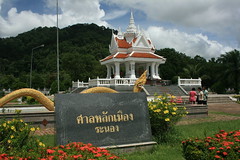
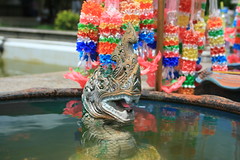
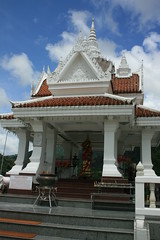
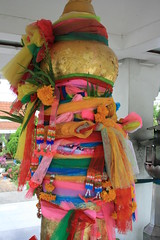
Whenever I visit a provincial capital, I try to make sure I drop by the city pillar shrine (Lak Mueng). Thus no different when I was in Ranong this year, the city pillar was the first stop on a tour through the town. It is located close to the Phetkasem highway, at the rim of Khlong Hat Som Paen (คลองหาดส้มแป้น). While the building itself is built in the same style as many of these shrines, so it did not impress me that much. However, the two pools in front with a Naga snake inside presented some nice photo opportunities, as you can see below. The complete set of photos is on flickr.

SignNaga
ShrinePillar top

Very close to the shrine, at the southern end of the small park, is another site worth visiting - a statue commemorating Phraya Rattanasetthi (Kho Su Chiang), the first governor of Ranong and founder of the na Ranong family.

Sunday, August 8, 2010

Museum Siam

One of the best museums in Thailand is the relatively new Museum Siam (มิวเซียมสยาม), located at the southern end of the Rattanakosin island in the former building of the Ministry of Commerce. I learned about it from the great website Tour Bangkok Legacies, where a lot of special places within Bangkok off the beaten track are featured. While it has only few original antique items - if you prefer to see that better go to the National Museum in the north of Rattanakosin -the way of presenting the history of Siam/Thailand is much easier accessible than in the older style presentation of the National Museum. And one big advantage of the latter - here photography in the museum is not only allowed, the clerk who sent me to the first room even explicitly notified me that I can take photos of everything. Also many exhibits are free to be touched for completely experiencing the items.


The first room is a big auditorium, where a short movie is shown as an introduction to the main theme of the museum - why is typically Thai. The movie also introduces the emblem of the movie, a red character in a frog style standing position. One will find many variations of the emblem in the later rooms, but very nice are those hanging in the staircase one has to go up to the third floor. But before the staircase one enters the first exhibit room, which is kind of a wild collage of all the cliches of typically Thai - Muay Thai, temple dancers, a spirit house, a street food carriage and of course inevitably a Tuk Tuk, ready to sit inside to pose.

Starting in the third floor with the early history - starting way before prehistory with the dinosaurs found in the Northeast, racing from the Lampang Man (Homo erectus) and the prehistoric remains, reaching the mostly mythological Suvarnabhumi country as the first main stop. Since Suvarnabhumi more refers to the whole South East Asia, on what later became Thai soil it had the first city states of the Dvaravati culture, which later became replaced by the first Thai city states.

With Ayutthaya being the most successful of these city states, the next room features beautiful boats hanging in the center and several dioramas depicting scenes from various times in this city - a royal cremation, a market, even a Christian church built by the western missioners. Another one room focuses on Buddhism, and one on the culture of war in these times.

One floor down the exhibitions continues with the map room, not only showing old maps like the famous Carte du Royaume de Siam et des Pays Circonvoisins and the first modern cartographic map of McCarty finished in 1897, but even more notable the depiction of the change of the boundaries of Siam is critical of the nationalistic use of these maps and - of course hardly possible in such a short presentation - shows many of the main points of the highly recommended book "Siam Mapped".

The various cultures in Siam at the beginning of the 20th century are shown in small windows with audio and video, and small items typical of them - I photographed the Chinese as the most iconic of them.

The contrast between the farming communities and the modern technology coming into Siam at that time is shown next, including the first postbox of Siam. Next step is already the nationalist Phibun regime, again (at least in English) the description of the displayed items is notable critical of the ideas of these times, where anyone who disagreed with the government policies was termed non-Thai.

A 1960s TV station where one can try to sit as a news announcer in front of the camera is next, and a bar of the about the same time. A time tunnel into the future is then the exit of the exhibition.

The only point I could criticize about the museum is the pricing - like many venues it does the infamous double pricing, whereas foreigners pay 300 Baht, while Thai only pay 100 Baht. It is worth the inflated price nevertheless, but would probably attract even more foreigner with a more fair pricing - and an English website would definitely help to spread to word better, inside the museum everything is bilingual already. Whereas many museums in the western countries have their exit directly into the museum shop, I completely failed to find the museum shop here and wondered why there's no merchandise with that nice emblem. Only after I checked the website again later I noticed that there is a museum shop, but it must be quite well hidden.

Also notable is the fact that this museum is the first one in Thailand which is present in the Web 2.0 - they're quite active on Facebook as well as Twitter; and there are two branch museums planned already, one in Lampang and one in Chanthaburi. When I come in either of these cities these museums will definitely be on my itinerary.

Sunday, July 25, 2010

Wat Phra Boromathat Chaiya

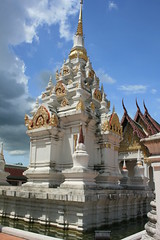
ChediWat Phra Boromathat Chaiya Rat Worawihan (วัดพระบรมธาตุไชยาราชวรวิหาร) is the most important Buddhist temple of Surat Thani, and also one of the most beautiful ones. The central chedi in Srivijaya style with its many golden ornaments is even the iconic symbol of the province Surat Thani.

The reason why the main temple of the province is not located in the provincial capital lies in the history of the province. In fact, the temple was originally in the capital of the Mueang Chaiya, one of the semi-independent city-states which made up Siam until the administrative system was completely overhauled at the begin of the 20th century. Though by then the town Chaiya was moved closer to the sea to present-day Phum Riang - it came back to its original location after the railway was built in 1915. However, by then the province Surat Thani was established by merging the area formerly under Chaiya with the one under Kanchanadit, and the new center of the province was at the mouth of the Tapi river in Ban Don.

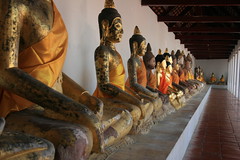
Buddha rowEvery side of the chedi shows a different ornament, though I don't know much about the actual meaning. Pointing north is a peacock, to the south is Erawan as the multi-headed elephant, to the east a Buddha surrounded by regalia which reminded me of the old coat of arms of Siam. The one on the west side I could not recognize at all. The chedi is surrounded by a walkway with lots of Buddha statues, and several smaller chedis, elephant and other statues, as well as nice small trees. If only it were not so hot and sunny, which made walking around on the hot plaster barefooted far from comfortable.

Much less spectacular than the chedi is the bot, though religiously it is the more important building. Inside are just several smaller Buddha statues, and no murals at the walls.

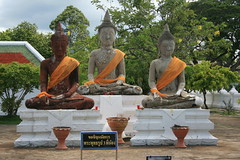
Three BuddhasThe three Buddha statues outside next to the Bot are also notable. Normally Buddha statues are always under a roof protected from the elements, however these three are believed to prefer to stay outside - when they were placed under a roof in past, lightning struck and destroyed the building. I don't know if and when this story actually took place, but it sounds like a perfectly fit explanation for these statue's location.

Directly at the temple is also a local branch of the National Museum, which has several items from the Srivijaya times on display. Sadly not allowing photography I did skip the revisit and focused on taking photos of the temple instead. Since I did quite a lot of photos, like the views of the chedi from all four sides, I uploaded the whole collection to flickr.

Sunday, July 11, 2010

District museum Yannawa

When I read about Richard Barrow's test ride on the BRT, I was curious to try this new bus system myself. Looking at the route map, I noticed that along the route it has the BMA local museum of Yannawa district, though in between two widely spaced stations, so I had to do quite some walking to get there as well. Nevertheless, this new public transport opens up a new part of Bangkok for those who prefer public transport over taxis, even though these aren't expensive in Bangkok.

The trip to this museum was definitely worth it. Though the museum is a rather small one compared to some other of the district museums I visited, what made it a special visit was the caretaker. The nice woman not only showed me around the items on display, explained them in Thai (sadly I only got maybe 10% of what she told) and also helped me to take good photos by flipping open one Sanskrit manuscript. Not sure what it showed however, but it looked like something about astrology or the calendar. Since she noticed I was quite sweaty from the walk to the museum - it was a rather hot and very sunny day - she also gave me a bottle of water, and a small pack of cookies for snack. I even could get one of the very last copies of the brochures on Yannawa district which she found deep inside a drawer of her desk, hope it wasn't the last one kept for the museum itself.

She not only showed the museum itself, but also the temple where it is housed. Though Wat Khlong Phum (วัดคลองภูมิ) is none of the spectacular temples, it has some interesting sights as well. There are Buddha statues from Ayutthaya times, sadly locked behind bars to prevent theft but which also made photography very difficult; a quite old monk's quarter; the crematorium gave a great view with two failed skyscrapers abandoned in the 1997 Asian crisis in the background; and of course the bot and a viharn next to it also look great, too bad they weren't open to see inside.

My guide even wanted to make sure I will take the right bus to go to my next target, the Bangkok Folk Museum in Bang Rak district (to be featured here later), so she even went to the bus stop in front of the temple with me. I planned to continue my trip by walking to the next BRT station, and then walk within Bang Rak, but it took me a bit to explain my itinerary to her with my still bad Thai.

I had experienced several very good caretakers in the local museums, who very much tried to make my visit worthwhile, but the one in Yannawa topped it all. So if anybody visits this museum after reading my review, make sure to tell her it was "Khun Andreas" from Germany who made you go there.

Sunday, June 27, 2010

Grass hill in Ranong


Phu Khao Ya (Grass Hill, ภูเขาหญ้า) or Khao Hua Lan (Bald Hill, เขาหัวล้าน) is an odd landscape feature a few kilometers south of Ranong town directly along Phetkasem highway. Unlike most hills, it is not covered with trees, but only grass, hence the names grass hill or bald hill. Since it was the last stop of a day tour through Ranong, there was not much time left to explore the place in details and walk around on the various trails over and around the hills, but just take the few photos and then continue the return drive to Surat Thani.

But even though it were only a few minutes I walked from parking lot to the most scenic view, the landscape looked really very interesting. I could not find yet what made this hill show this peculiar vegetation, I can only guess it is a secondary landscape with the soil loosing its ability to nourish trees after being deforested. Especially the area between the highway and the hill looks very much like it was made into a meadow for grazing animals.

Apart from too short, the time of the visit was also a bit badly chosen - as it was in later afternoon, the sun was already relatively low in the west, and therefore directly behind the hill when seen from street. At least from the scenic viewpoint it wasn't making photography impossible - it was one of the few days in Ranong on which it had no raining at all, but most of the time sunny. Probably in the morning sun the hill will look even better than it did for me.

Sunday, April 4, 2010

Wat Amphawa Chediyaram

With the Amphawa floating market becoming more and more popular as an more authentic alternative to the standard tourist target at Damnoen Saduak, I have used the opportunity to drop it a visit as well. Though I think it is definitely worth a visit, I instead write about the temple right next to it, which normally visitors to the market only notice as their parking lot. Since shopping isn't among my favorite pastimes, I had some time to spend while the family was still busy, and did some walking around the temple complex. It was quite surprising how few people I saw strolling around there, compared to the crowded market area.

Most beautiful is the main hall, which contains the large Buddha statue. While for me as a non-Buddhist the statue did not look any special, the murals on the walls were the most interesting thing to look at in the hall. The one behind the Buddha statue shows, if I am not totally mistaken, the former capital city Ayutthaya before it was destroyed by the Burmese in 1767. But not only the mural behind the Buddha is worth looking at, between each window it has one showing some historical or mythological scenes. It even has small signs under them explaining what it depicted - but sadly only in Thai, so I could not understand which one is the most notable of these murals.

But not just this main hall of the temple has something special to show, in a small and inconspicuous building is another Buddha statue, and more notable a large footprint. Light inside was a bit weak, so the photo turned out to be a bit blurred, I did not bring the tripod since most of the photos I do in Thailand are in the strong sun outdoors, when a tripod is only unnecessary weight.

The final building I entered is the courtyard, a walkway with the donated Buddha statues at the walls, and a white chedi in the middle. Though this part looked so similar to the ones I had seen in countless other temples already, here's a photo of the smaller statues.