Sunday, January 31, 2010

District museum Khlong San

Udom Wittaya libraryThe smallest of the Bangkok district museums I have visited so far is the on of Khlong San district, just across the river from Chinatown. It is located within the public library of Wat Anongkharam (วัดอนงคาราม), named Udom Wittaya library (หอสมุดอุดมวิทยา). I love libraries, just sadly it has only Thai books in this one so there was no point in browsing through the shelves - besides I was coming there in late afternoon and it seemed they were about to close soon anyway.

Portrait of Somdet Ya, Khlong San district museumThe museum is in the first floor, just up the stairs and then to the right. When I entered, I asked the clerk at ground floor for the location of the museum with those few Thai words I can say, so she directed me upstairs and gave a warning call to the one upstairs that it has a farang coming for the museum. I guess foreigner are a rare sight in there, like in all of these museums.

The central place of the museum area is taken by a portrait of Somdet Ya, the mother of King Bhumipol. She was educated in this temple, and close by the temple a Somdet Ya garden was established around a reconstructed house of your youth.

Khlong San district museum exhibitsOther exhibits include old tools used by the main professions in the district, like those salt drying tools I photographed. There's also a bell from the Khlong Sa-Tha Chin railway - originally the Maeklong railway started in this district, now the endpoint is at Wong Wian Yai. Another nice antique exhibit is a metal shop sign; also shown are a few Khon masks manufactured in the district - Ban Khon Thai (บ้านโขนไทย) is located in Khlong San.

The museum is most worth if you combine the visit with the already mentioned nearby Suan Somdet Ya, and the temple Wat Pichai Yat, which I may write about later as well.

Sunday, January 10, 2010

Phum Riang silk village

Phum Riang in Chaiya district, northern Surat Thani province, is a small Muslim fishing town, which however is famous for the hand-woven silk products. Like many me, shopping for handicrafts, especially textiles, isn't my favorite kind of activity, but when we went to the main shop in the town last time after a short look around my mother-in-law led to the back exit of the shop right into the working area of the weavers.

Since it was on the day after Songkhran, only very few workers were there, so I could look around without worrying to disturb them by my curious looks, photography or by simply standing in the way. Still I could see the dyeing of the silk, the rolling-up of the freshly dyed silk, as well as one loom in action weaving some clothes. Yet since it was very tightly packed in there it was not easy to catch the loom on photo.

As we had to travel there on Songkhran - in evening my mother-in-law had her annual school reunion nearby - and therefore the main street was full of the youth playing with water, thus I did not dare to stroll around the town for other sights to keep my camera dry. Which is actually a pity as Phum Riang is quite a significant town despite its present remoteness. Phum Riang was the seat of the province Chaiya, before it was merged with Kanchanadit in 1899 and the seat was moved to Bandon, the present day city of Surat Thani. When the railway was built, the new settlement Talat Chaiya was built. I am not sure which year the district administration moved from Phum Riang to Talat Chaiya, but today the only office left in Phum Riang is the municipality administration.

I doubt any of the old administrative buildings still survive after about 100 years, but at least the historical temples still are on my list of places to visit when I return there next time.

Monday, November 30, 2009

Don Wai market

A daytrip from Bangkok I have done three times already is the market at Don Wai, close to Phutthamonthon in Nakhon Pathom province. It is a huge market where almost everything is sold - from fresh fruits, herbs, dried and fresh fish, up to all the different kinds of sweet snacks. But also toys, Buddha statues, even plants are on sale there. And of course there are several restaurants. Especially for Thais this market is already the prime attraction, yet what I enjoy most there are the boat trips on Tha Chin river.

Since on our latest visit there I had my GPS tracker with me, I could make a map showing the exact way the boat took - from the pier at Don Wai till the bridge at Wat Rai Khing in Tha Talat, and back. At the turning point it had the standard activity of Thai at water bodies - feeding the fish with bread. Also a small boat with a ice-cream dealer docked to sell a snack.


View Larger Map

From the river one can see all different types of housing, from very plain houses up to villas, mostly on the western shore. On the east shore it has two temples, Wat Rai Khing at the turning point and Wat Tha Phut a bit upriver. But what makes the trip most enjoyable is that we always bought many things to eat before and brought them on the boat - in the first trip, which was at my first trip to Thailand, I even had a complete lunch on the boat.


Though it is mostly used as the parking lot of the market, the temple Wat Don Wai is also worth a short visit. I don't know why, but the photos of that temple looked almost artificial in their colors, and I did nothing like HDR with them.

For the full set of photos see the Don Wai set at flickr.

Sunday, November 15, 2009

Wat Phonimit, Surat Thani

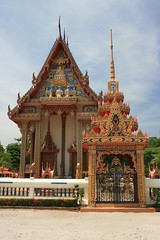
BotThe temples within the city Surat Thani did not impress me that much, there are neither really historical ones - maybe except the one building of Wat Pattanaram - nor as lavishly decorated. Slighly outside the city center however is one temple which is worth a short visit just to admire the architecture and handicraft necessary to create it. Of course compared with the temples in Bangkok it is just a normal one, yet for Surat Thani city it is apparently the most interesting one.

Named Wat Phonimit (วัดโพธิ์นิมิต), the temple is located on the road towards Kanchanadit, about 4 kilometer from the city center. I went there together with family, and while they attended a ceremony in the Sala I was free to stroll around in the temple complex and took lots of photos.

Lions in front of BotThe main building is of course the Ubosot, most lavishly decorated and with a small fence around it. The gate inside as well as lion statues, and of course the gable of the building made great photo locations. Note the wasp nest glued on the gable in one side. Sadly the building was locked, so I could not get a view on the Buddha statue inside, or see if it has any interesting murals on the walls inside.

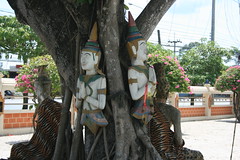
StatuesInteresting were also several statues located around a tree, the hermits in behind I could recognize, yet I don't know about the symbolism of the other figures. Also, several smaller chapels and Salas are spread over the compound, for example the one housing three monk statues.

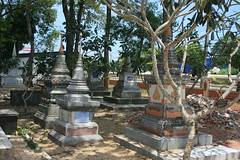
GraveyardSeparated from the main compound by the street towards Rama IX park is the crematorium and the graveyard - the small chedis house urns of the deceased.

Since I could not add all the photos here I have created a set on Flickr, and when I have the chance to add more photos of the place I will put them there as well.

Sunday, October 25, 2009

House of Museums

A very interesting museum in the western outskirts of Bangkok is the House of Museums (บ้านพิพิธภัณฑ์), where lots of everyday items of the 1950s and 1960s are collected and displayed.

On the ground floor is one corner with lots of toys, mostly tin toys, and since we went to the museum with our small daughter this corner we spend most of the time - she could not get her eyes off from the many toys, all so much different from those she is used to nowadays. There are further two old style shops, though while such a shop layout itself can still be found in Thailand away from the big malls of Bangkok, I could only wonder that so many of the old product packaging was kept by collectors. There also a small shop of old-style toys, though most in plastic already, as well as some treats. Also, directly at the entrance next to the counter are the books by Anake Nawigamune (เอนก นาวิกมูล), the founder of the museum and a very productive writer on many historical topics. Sadly the books are all only in Thai, only the photos inside might be of interest for those living behind the language barrier.

The first floor features a printing press, a barber shop, a photographer shop, and a kitchen, all with the historic utensils. Another room just has many mixed historic items, like a historic playing car, musical instruments, games, dolls. Even more interesting for me was the second floor, especially the office of a district officer as well as an old school room. Finally on the ground floor of the neighboring house is the workplace of a dentist, a Chinese gold shop (still looking much similar to the ubiquitous gold shops of Bangkok).

Though we spend more than an hour in there, we had to hurry through the last rooms since we had another appointment later the day. But as this museum is located close to the home of my brother-in-law, it won't be my last visit there for sure.

The museum is run by a private club and is therefore only open in the weekends when the members don't need to work. It is quite easy to find when driving yourself, from the city center on the highway to Nakhon Pathom (but don't use the elevated one which has only few exits), then right after the intersection with the ring highway change to Phutthamonthon Sai 2 to north, turn left at the end and shortly after at the sign left again.

Sunday, October 4, 2009

Baan Rabiang Dao resort near Khao Yai

Normally I don't write about resorts or hotels here, as for me these are mostly the places to spend the night and I prefer to explore the attractions around. So we don't go to the expensive resorts and choose a plain hotel room instead. But since it was a nice and special place we stayed together with the Thai family two years ago I'll give it a try to deviate from the normal contents here this time. Just to make it clear - I wasn't paid for this posting, nor am affiliated in any way with the resort.

The resort is named Baan Rabiang Dao, yet the part we stayed was named Ban Ruea Resort (บ้านเรือรีสอร์ท), literally house boat resort. The name and the photos already explain the theme of the resort - the rooms are inside traditional styled houseboats. As we were traveling with all family we filled a large boat completely - actually we were even more than the 6 persons normally planned for a single home. As it is a relatively expensive resort we only stayed one night, but it was definitely a pleasant stay. Especially the children liked the pool a lot, and luckily we could borrow swimming suits from the resort as not all of us did bring our own.

The resort is located near Khao Yai national park, and it was very quiet around it. Only when I now searched to pinpoint the location exactly I learned that very close to the resort is the Gran Monte winery - we visited a winery next day, but that was the Vin de Ray in neighboring Saraburi.

Sunday, September 27, 2009

District museum Thonburi

One of the local district museums I should mention here is the one of Thonburi. It is relatively easy to reach, has several nice exhibits, but most of all the caretaker was that much concerned about me getting most of the museum it was nearly annoying already. As she did not speak much English, she instead read the text on the plates next to the exhibits.

The museum is located in the 3rd floor of the temple school of Wat Prayurawongsawat, most famous for the replica mountain known as "turtle mountain". It is located right across the river at Memorial Bridge. The temple itself is also worth a visit, but one wouldn't find this museum at all strolling around on the temple grounds. It has a sign on the street outside the temple complex, but not a single hint inside to guide to the school. In the brochure of the temple it has a photo of a sign in front of the school, but I did not notice that one in there. So once I found the school building I asked at the kiosk in front and it quickly had someone guide me upstairs to the rooms occupied by the museum. Felt quite odd to pass the school rooms full with pupils to reach a museum.

The museum itself consists of two rooms, and since it was a very hot day and I was on a walking tour visiting several of these museums the fact one of it was acclimatized was quite comfortable. Since the district shares its name with the historical capital - though the actual palace back then is in Bangkok Yai now - and the former province covering the area west of the Chao Phraya river, these histories are prominently displayed on the posters. It was one of these posters where I learned that the former province hall of Thonburi is located just around the corner of the temple.

Of course the local artisans are featured as well, music instruments from (if I recall correctly) Lao settlers including audio recordings to listen, or the Khon mask shown to the left. Also, photos and descriptions of the main religious sites in the district are shown - apart from the Buddhist temples Wat Kanlayanamit and Wat Prayurawongsawat the Santa Cruz church and the only Mosque built like a Thai temple building are the most prominent ones. These alone already gave me enough ideas of places to visit next time I am out for a walking tour in Thonburi.