Sunday, April 4, 2010

Wat Amphawa Chediyaram

With the Amphawa floating market becoming more and more popular as an more authentic alternative to the standard tourist target at Damnoen Saduak, I have used the opportunity to drop it a visit as well. Though I think it is definitely worth a visit, I instead write about the temple right next to it, which normally visitors to the market only notice as their parking lot. Since shopping isn't among my favorite pastimes, I had some time to spend while the family was still busy, and did some walking around the temple complex. It was quite surprising how few people I saw strolling around there, compared to the crowded market area.

Most beautiful is the main hall, which contains the large Buddha statue. While for me as a non-Buddhist the statue did not look any special, the murals on the walls were the most interesting thing to look at in the hall. The one behind the Buddha statue shows, if I am not totally mistaken, the former capital city Ayutthaya before it was destroyed by the Burmese in 1767. But not only the mural behind the Buddha is worth looking at, between each window it has one showing some historical or mythological scenes. It even has small signs under them explaining what it depicted - but sadly only in Thai, so I could not understand which one is the most notable of these murals.

But not just this main hall of the temple has something special to show, in a small and inconspicuous building is another Buddha statue, and more notable a large footprint. Light inside was a bit weak, so the photo turned out to be a bit blurred, I did not bring the tripod since most of the photos I do in Thailand are in the strong sun outdoors, when a tripod is only unnecessary weight.

The final building I entered is the courtyard, a walkway with the donated Buddha statues at the walls, and a white chedi in the middle. Though this part looked so similar to the ones I had seen in countless other temples already, here's a photo of the smaller statues.

Sunday, February 28, 2010

District museum Samphanthawong

The district museum of Samphanthawong district, which basically is Chinatown, was originally located within Wat Traimit, the famous golden Buddha temple. It was however removed there in 2006 in order to make space for the massive rebuilding of Wat Traimit, which now has been fully opened. Within the temple it now has a new local museum on the history of Chinatown, the Yaowarat Heritage Centre, a museum I will try to visit in my next trip to Thailand.

The original district museum was however not completely abandoned, it was moved into the Pathum Kongka temple school, only one block away from its original location. To visit it, one however really has to know where to search, as there is no sign at the school entrance nor at the school building which houses the museum. When I went there, the school entrance was blocked by a goal net, as the students played soccer in the inner courtyard, so I had to ask me way through. I was guided to the office building to the right, the upper floor now houses the museum.
The main exhibit in the museum is a row of Chinese shop houses, one with traditional Chinese medicine, a rice trader and a general store. In the larger room it mostly has posters showing reproductions of historic photos with explanation, both in English and Thai, giving an overview of the Chinese community.

Given the much bigger, more elaborate and better located new museum, and even more the total lack of promotion by the Bangkok tourist office (who told Eric from the Tour Bangkok Legacies website that the museum is still in Wat Traimit even after he noticed it being gone) as well as the total lack of signs towards to museum, I doubt it will attract any reasonable number of visitors except those who were able to find the sparse information on it. Though the Song Wat road, at which the museum is located, has far less tourists walking by than on Yaowarat road, one or two English sign would increase the visitor numbers already a lot.

Sunday, February 14, 2010

Vin de Ray winery

Vin de Ray vineyardVin de Ray (แวงเดอร์เรย์) is a small but high quality winery in Saraburi. If I remember right, it belongs to a Thai TV personality, but the wine is available for sale there in a small shop as well, so it is not solely for the personal fun of this personality. We bought a few bottles, and unlike a Thai wine I once bought in a supermarket and which tastes quite strange, the red wine we bought was same quality as the European ones. At least for the taste of a casual wine drinker. The only other thing we did there was photo taking, while I took only the vineyard with a few workers in behind, whereas my family did many photos posing in front of vine and grapes. Also, for me the large yellow shower tree gave a great color contrast with the blue sky.

Yellow shower treeThe drive to there is also interesting. When coming from Muak Lek, one first passes a stretch of road named mystery road, as its one of those roads where the law of gravity seems to be violated. The car apparently rolls uphill, but of course this is only an optical illusion - which somehow did not work for me. A little later is a much more fascinating one, the tree tunnel. The road goes through a forested valley, and the trees have grown over the road so one drives through a nature-built tunnel. Too bad we did not stop for a photograph there.

Sunday, January 31, 2010

District museum Khlong San

Udom Wittaya libraryThe smallest of the Bangkok district museums I have visited so far is the on of Khlong San district, just across the river from Chinatown. It is located within the public library of Wat Anongkharam (วัดอนงคาราม), named Udom Wittaya library (หอสมุดอุดมวิทยา). I love libraries, just sadly it has only Thai books in this one so there was no point in browsing through the shelves - besides I was coming there in late afternoon and it seemed they were about to close soon anyway.

Portrait of Somdet Ya, Khlong San district museumThe museum is in the first floor, just up the stairs and then to the right. When I entered, I asked the clerk at ground floor for the location of the museum with those few Thai words I can say, so she directed me upstairs and gave a warning call to the one upstairs that it has a farang coming for the museum. I guess foreigner are a rare sight in there, like in all of these museums.

The central place of the museum area is taken by a portrait of Somdet Ya, the mother of King Bhumipol. She was educated in this temple, and close by the temple a Somdet Ya garden was established around a reconstructed house of your youth.

Khlong San district museum exhibitsOther exhibits include old tools used by the main professions in the district, like those salt drying tools I photographed. There's also a bell from the Khlong Sa-Tha Chin railway - originally the Maeklong railway started in this district, now the endpoint is at Wong Wian Yai. Another nice antique exhibit is a metal shop sign; also shown are a few Khon masks manufactured in the district - Ban Khon Thai (บ้านโขนไทย) is located in Khlong San.

The museum is most worth if you combine the visit with the already mentioned nearby Suan Somdet Ya, and the temple Wat Pichai Yat, which I may write about later as well.

Sunday, January 10, 2010

Phum Riang silk village

Phum Riang in Chaiya district, northern Surat Thani province, is a small Muslim fishing town, which however is famous for the hand-woven silk products. Like many me, shopping for handicrafts, especially textiles, isn't my favorite kind of activity, but when we went to the main shop in the town last time after a short look around my mother-in-law led to the back exit of the shop right into the working area of the weavers.

Since it was on the day after Songkhran, only very few workers were there, so I could look around without worrying to disturb them by my curious looks, photography or by simply standing in the way. Still I could see the dyeing of the silk, the rolling-up of the freshly dyed silk, as well as one loom in action weaving some clothes. Yet since it was very tightly packed in there it was not easy to catch the loom on photo.

As we had to travel there on Songkhran - in evening my mother-in-law had her annual school reunion nearby - and therefore the main street was full of the youth playing with water, thus I did not dare to stroll around the town for other sights to keep my camera dry. Which is actually a pity as Phum Riang is quite a significant town despite its present remoteness. Phum Riang was the seat of the province Chaiya, before it was merged with Kanchanadit in 1899 and the seat was moved to Bandon, the present day city of Surat Thani. When the railway was built, the new settlement Talat Chaiya was built. I am not sure which year the district administration moved from Phum Riang to Talat Chaiya, but today the only office left in Phum Riang is the municipality administration.

I doubt any of the old administrative buildings still survive after about 100 years, but at least the historical temples still are on my list of places to visit when I return there next time.

Monday, November 30, 2009

Don Wai market

A daytrip from Bangkok I have done three times already is the market at Don Wai, close to Phutthamonthon in Nakhon Pathom province. It is a huge market where almost everything is sold - from fresh fruits, herbs, dried and fresh fish, up to all the different kinds of sweet snacks. But also toys, Buddha statues, even plants are on sale there. And of course there are several restaurants. Especially for Thais this market is already the prime attraction, yet what I enjoy most there are the boat trips on Tha Chin river.

Since on our latest visit there I had my GPS tracker with me, I could make a map showing the exact way the boat took - from the pier at Don Wai till the bridge at Wat Rai Khing in Tha Talat, and back. At the turning point it had the standard activity of Thai at water bodies - feeding the fish with bread. Also a small boat with a ice-cream dealer docked to sell a snack.


View Larger Map

From the river one can see all different types of housing, from very plain houses up to villas, mostly on the western shore. On the east shore it has two temples, Wat Rai Khing at the turning point and Wat Tha Phut a bit upriver. But what makes the trip most enjoyable is that we always bought many things to eat before and brought them on the boat - in the first trip, which was at my first trip to Thailand, I even had a complete lunch on the boat.


Though it is mostly used as the parking lot of the market, the temple Wat Don Wai is also worth a short visit. I don't know why, but the photos of that temple looked almost artificial in their colors, and I did nothing like HDR with them.

For the full set of photos see the Don Wai set at flickr.

Sunday, November 15, 2009

Wat Phonimit, Surat Thani

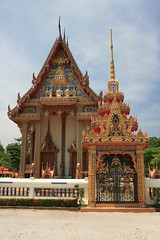
BotThe temples within the city Surat Thani did not impress me that much, there are neither really historical ones - maybe except the one building of Wat Pattanaram - nor as lavishly decorated. Slighly outside the city center however is one temple which is worth a short visit just to admire the architecture and handicraft necessary to create it. Of course compared with the temples in Bangkok it is just a normal one, yet for Surat Thani city it is apparently the most interesting one.

Named Wat Phonimit (วัดโพธิ์นิมิต), the temple is located on the road towards Kanchanadit, about 4 kilometer from the city center. I went there together with family, and while they attended a ceremony in the Sala I was free to stroll around in the temple complex and took lots of photos.

Lions in front of BotThe main building is of course the Ubosot, most lavishly decorated and with a small fence around it. The gate inside as well as lion statues, and of course the gable of the building made great photo locations. Note the wasp nest glued on the gable in one side. Sadly the building was locked, so I could not get a view on the Buddha statue inside, or see if it has any interesting murals on the walls inside.

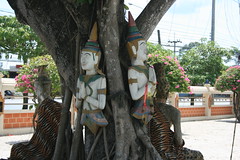
StatuesInteresting were also several statues located around a tree, the hermits in behind I could recognize, yet I don't know about the symbolism of the other figures. Also, several smaller chapels and Salas are spread over the compound, for example the one housing three monk statues.

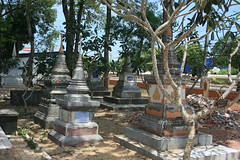
GraveyardSeparated from the main compound by the street towards Rama IX park is the crematorium and the graveyard - the small chedis house urns of the deceased.

Since I could not add all the photos here I have created a set on Flickr, and when I have the chance to add more photos of the place I will put them there as well.